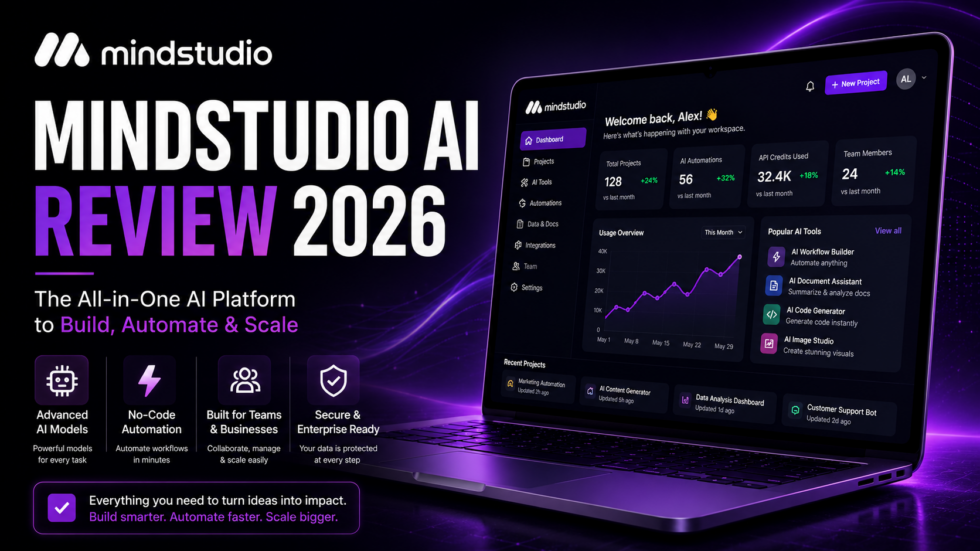
AI agents are moving beyond simple chatbots.
The more interesting question in 2026 is no longer:
“Which AI model should I use?”
It is:
“How do I turn AI into a system that can actually complete work?”
That means connecting models to data, APIs, business applications, decision logic, triggers, human approvals, and multi-step workflows.
Building all of that manually can quickly become complicated.
MindStudio takes a different approach.
It provides a visual environment for creating, deploying, and managing AI-native agents and workflows—while giving users access to more than 200 AI models from providers such as OpenAI, Anthropic and Google.
Instead of building every AI workflow from code, MindStudio lets you combine models, prompts, data sources, logic and integrations into reusable agents.
But how useful is it compared with platforms such as Zapier, Make, n8n or custom AI development?
In this MindStudio review 2026, we’ll explore what the platform does well, where it fits into the rapidly changing AI automation market, its pricing, limitations, and who should consider using it.
Quick Verdict
Best For: AI builders, marketers, agencies, operations teams, entrepreneurs, developers and businesses that want to build AI-powered workflows without maintaining the entire AI infrastructure themselves.
Standout Features: 200+ AI models, visual AI-agent builder, Agent Architect, RAG, MCP support, human-in-the-loop workflows, integrations, AI model routing and enterprise deployment options.
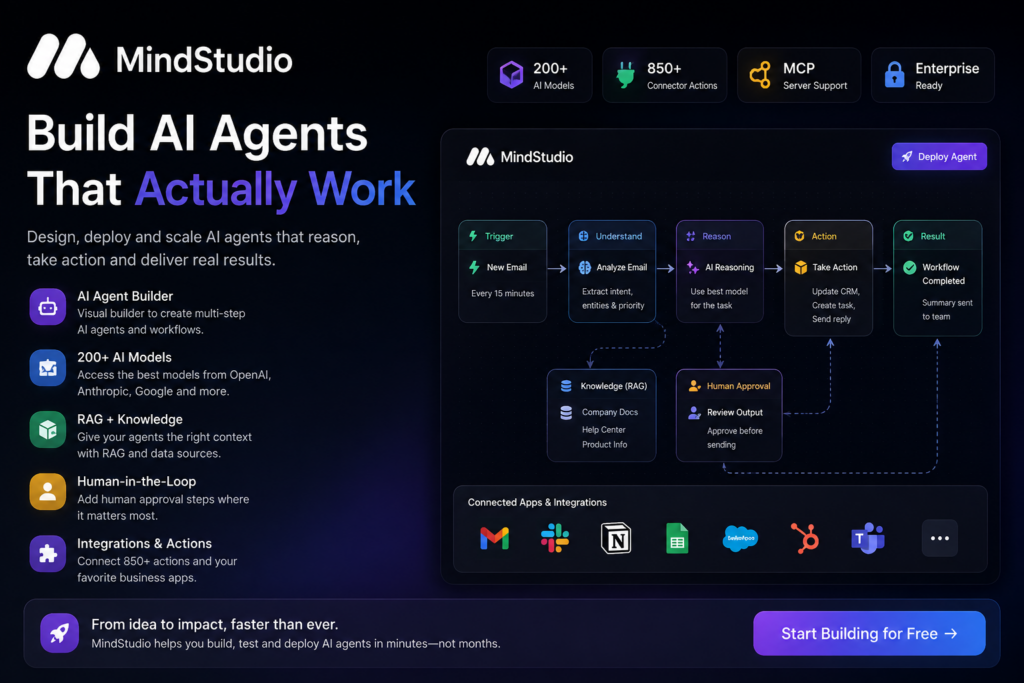
MindStudio Review 2026: Build AI Agents That Actually Work
MindStudio Isn’t Just Another AI Chatbot
This distinction is important.
MindStudio isn’t primarily trying to compete with ChatGPT as a place where you open a blank conversation and ask AI questions.
Its focus is AI-native workflow automation.
Think about a typical AI workflow.
You might want an AI system to:
Monitor a website → identify changes → analyze those changes → create a report → send the report to your team.
A language model can perform the analysis.
But something still needs to:
- Visit the website
- Extract information
- Trigger the process
- Pass information to the model
- Decide what happens next
- Generate the output
- Send the result
- Run everything again tomorrow
That’s the infrastructure problem MindStudio is trying to solve.
The platform describes itself specifically as a system for the creation, deployment and management of AI-native agents.
What Is MindStudio?
MindStudio is a platform for building AI agents and automated AI workflows.
It combines several components that would otherwise require separate tools or custom development.
You can connect:
AI Models
Prompts
Business Logic
Data
Integrations
Triggers
Actions
to create an agent that performs a complete task.
The platform currently provides access to more than 200 AI models, including models from major providers such as OpenAI, Anthropic Claude and Google Gemini.
And you’re not necessarily locked into MindStudio’s model access.
You can also bring your own API keys and connect your own models where appropriate.
The simplest way to think about MindStudio
Traditional chatbot:
User → AI → Answer
MindStudio:
Trigger → Data → AI → Logic → Tool → AI → Action → Result
That second architecture is considerably more useful for business automation.
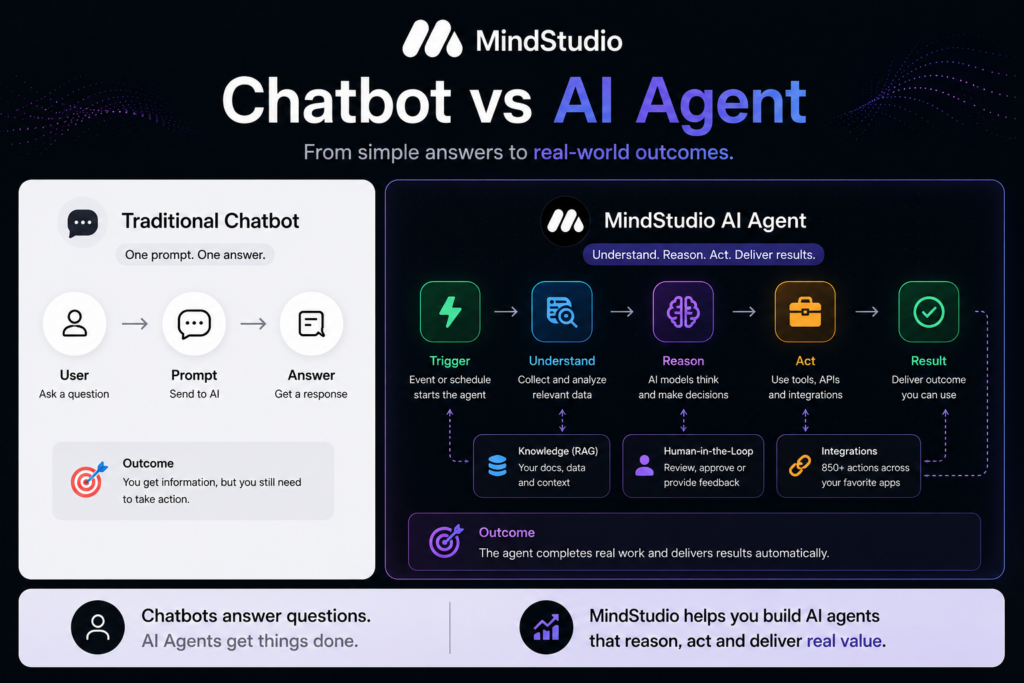
Chatbot vs MindStudio AI Agent Workflow
The Most Interesting Part: You Don’t Have to Choose One AI Model
Many AI platforms are fundamentally tied to one model provider.
MindStudio takes a more model-agnostic approach.
Its Service Router provides access to 200+ AI models, covering text, image and video generation.
That creates an important advantage.
Different AI models are good at different things.
You might prefer one model for reasoning, another for fast classification, another for image generation, and a cheaper model for repetitive text processing.
Instead of forcing every workflow through the same model, an AI-agent platform can use different models for different steps.
For example:
Step 1 — Fast Model
Classify incoming customer request.
↓
Step 2 — Advanced Reasoning Model
Analyze complex requests.
↓
Step 3 — Image Model
Generate required visual.
↓
Step 4 — Text Model
Prepare final response.
This can potentially improve both performance and cost efficiency.
No Separate AI Provider Accounts Required
Another useful detail is how MindStudio handles AI providers.
Normally, building a multi-model application could require accounts and billing relationships with several different companies.
MindStudio’s Service Router can handle those model connections centrally.
The company currently states that model usage is passed through at cost without additional markup.
Users who prefer direct provider relationships can bring their own API keys.
That creates two possible approaches:
Simpler setup
Use MindStudio’s model routing and centralized billing.
More control
Connect your own API keys.
This flexibility is useful as AI pricing and model quality continue changing rapidly.
Agent Architect: Describe What You Want to Build
This is where MindStudio becomes considerably more approachable for non-developers.
Instead of starting with an empty workflow canvas and manually configuring everything, MindStudio offers an Agent Architect.
The concept is similar to vibe coding.
You describe the agent you want.
For example:
Monitor competitors every day, identify meaningful changes to their products, summarize the changes and prepare a report.
Agent Architect can then create the initial agent structure.
You can continue describing changes rather than manually rebuilding every component. MindStudio currently positions this as a “vibe code AI agents” experience.
That dramatically changes the starting point.
Instead of:
Learn the platform → understand every block → design architecture → build
you move closer to:
Describe → Generate → Refine → Deploy
From Idea to AI Agent: Describe → Build → Connect → Deploy
What Can You Actually Build With MindStudio?
The answer is broader than it first appears.
Because agents can combine reasoning with actions, MindStudio can support workflows across many business functions.
Competitive Intelligence Agent
Imagine you run a SaaS company.
You could create an agent that periodically:
- Checks competitor websites.
- Extracts product and pricing information.
- Detects meaningful changes.
- Analyzes those changes.
- Creates a summary.
- Sends it to your team.
MindStudio itself uses competitor-monitoring workflows as an example of what its agents can automate.
Content Repurposing Agent
A marketer could build a workflow that accepts:
Article / Video / Transcript
and transforms it into:
- LinkedIn post
- Social caption
- Newsletter draft
- Content summary
- New content ideas
A human approval step can be inserted before publishing.
This is much more useful than repeatedly copying content between several AI tools.
Sales Research Agent
A sales workflow could:
Receive Company → Research Website → Identify Information → Analyze Account → Prepare Sales Brief → Send to CRM
The objective isn’t necessarily to remove the salesperson.
It’s to remove repetitive research before the salesperson begins meaningful work.
Email Assistant
MindStudio also highlights agents that can receive email and analyze the thread before identifying action items.
A workflow might look like:
Incoming Email
↓
Understand Conversation
↓
Extract Tasks
↓
Prioritize
↓
Prepare Response / Action Items
↓
Human Review
This demonstrates why AI workflow platforms can become more powerful than standalone chat interfaces.
RAG: Give Your Agent Its Own Knowledge
AI agents become much more valuable when they understand your own information.
MindStudio supports Retrieval-Augmented Generation (RAG) as one of its platform capabilities.
Instead of relying exclusively on a model’s general knowledge, you can connect information relevant to your workflow.
For example, a support agent could use:
- Product documentation
- Internal policies
- Help articles
- Training materials
The workflow becomes:
Question
↓
Search Relevant Knowledge
↓
Retrieve Context
↓
AI Reasoning
↓
Grounded Response
This can dramatically improve the usefulness of AI inside specialized business workflows.
Human-in-the-Loop Matters More Than Full Automation
One feature I particularly like conceptually is Human-in-the-Loop.
Not every AI decision should automatically trigger an external action.
Sometimes the better workflow is:
AI does 90% → Human approves final 10%.
Consider social media publishing.
An agent could:
Research → Draft → Generate Image → Prepare Post
and then stop.
A human reviews it.
Only after approval does the workflow publish.
That gives businesses the productivity benefits of automation without blindly handing every decision to AI.
Human-in-the-Loop is one of the capabilities MindStudio currently highlights alongside RAG, MCP Servers and multi-step reasoning.
Multi-Step Reasoning
Many useful business tasks cannot be completed with one prompt.
An AI may need to:
- Understand the objective.
- Gather information.
- Evaluate it.
- Decide what information is missing.
- Perform another action.
- Analyze the result.
- Produce an output.
MindStudio supports multi-step reasoning workflows, allowing agents to perform more sophisticated sequences than a simple prompt-response interaction.
This is an important distinction between AI generation and AI automation.
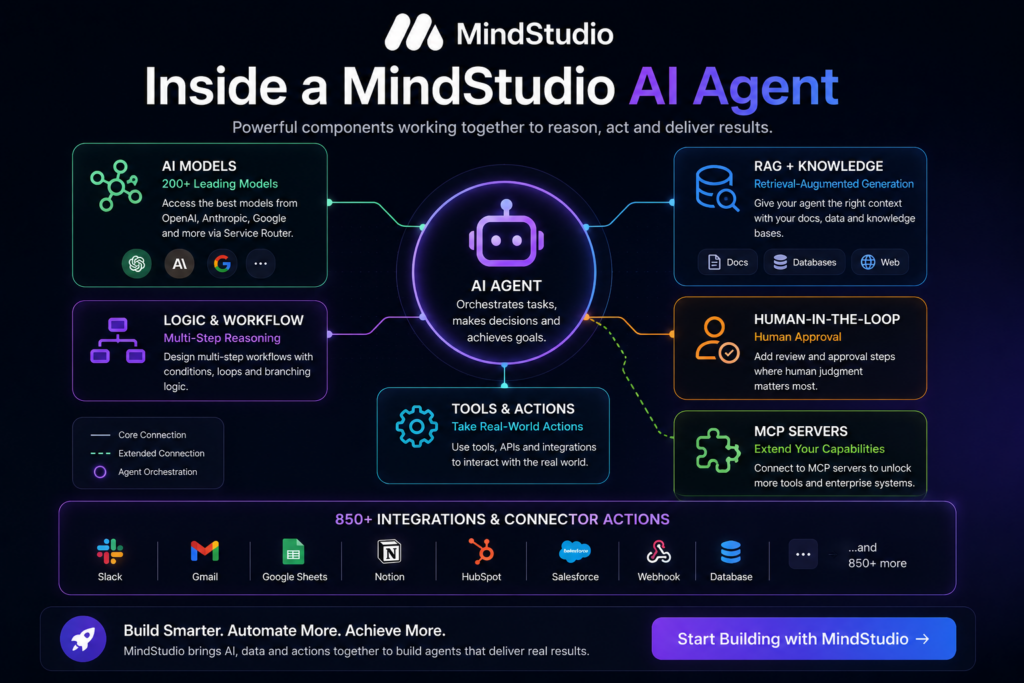
MindStudio Agent Toolkit: Models + RAG + Logic + Human Approval + MCP
MindStudio’s New Agent Skills Layer Is Worth Watching
One of the more interesting developments is MindStudio’s expansion into an action layer for external AI agents.
Its Agent Skills Plugin is designed to give agent frameworks access to real-world capabilities through a typed SDK.
MindStudio currently advertises:
140+ built-in actions
850+ connector actions
200+ AI models
and
1,000+ total capabilities
through this ecosystem.
This means MindStudio isn’t only trying to be the place where you build an agent.
It can also provide capabilities to agents built elsewhere.
What Can Those Agent Skills Do?
The current Agent Skills catalog includes functionality covering areas such as:
- Web scraping
- Google search
- Image generation
- Media analysis
- Audio transcription
- Text-to-speech
- CRM operations
- Documents
- Workflow execution
- Third-party integrations
MindStudio illustrates workflows such as:
Competitive Monitoring
Web → Analyze → Email
and:
Blog Pipeline
Research → Write → Generate Image → Publish
as examples of chained agent actions.
This is an important direction for the platform because AI agents need more than intelligence.
They need tools.
MCP Support
MindStudio also supports MCP Servers.
MCP allows AI applications and agents to interact with external capabilities through standardized interfaces.
For businesses experimenting with agentic systems, this can reduce some of the complexity involved in connecting agents to external tools.
MindStudio lists MCP Servers among its core platform capabilities.
850+ Connector Actions
Integrations are where automation platforms live or die.
An AI workflow that cannot interact with the software your business already uses isn’t very useful.
MindStudio’s newer agent tooling advertises access to more than 850 connector actions through third-party services.
This can help agents move from:
“Here is what you should do.”
to:
“I completed the workflow.”
That distinction is fundamental to agentic AI.
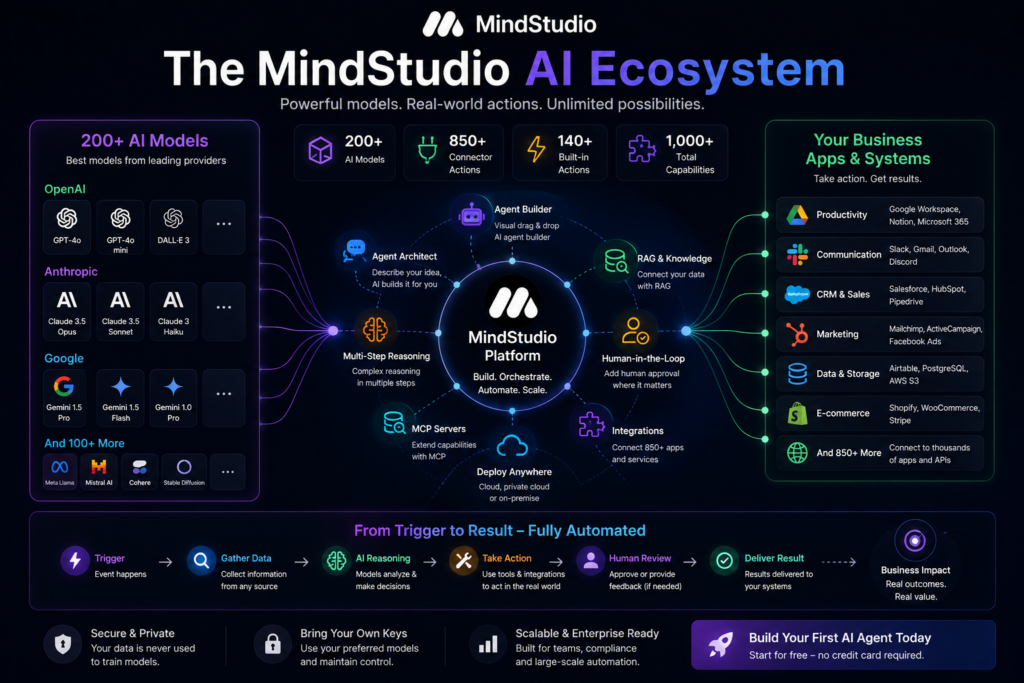
MindStudio AI Ecosystem: 200+ Models → 1,000+ Capabilities → Business Apps
MindStudio vs Zapier, Make and n8n
This comparison is inevitable.
All four platforms can automate workflows.
But they start from different assumptions.
Traditional Automation
Zapier, Make and n8n traditionally focus on:
Trigger → Logic → Action
AI can then be inserted into that workflow.
MindStudio
MindStudio starts from the perspective of:
AI Agent → Reasoning → Tools → Workflow → Action
MindStudio itself explicitly positions the product as AI-native workflow automation and compares its experience with Zapier, Make and n8n.
That doesn’t automatically make MindStudio better.
It makes the ideal use case different.
MindStudio makes sense when:
AI reasoning is the center of your workflow.
Traditional automation makes sense when:
Most of the workflow is deterministic app-to-app automation with only occasional AI steps.
There will naturally be significant overlap between these categories as automation platforms add more AI-agent functionality.
MindStudio for Marketing
Marketing is one of the easiest areas to imagine using the platform.
Agents could automate parts of:
- Content research
- Competitive monitoring
- SEO research
- Content repurposing
- Social content preparation
- Campaign analysis
- Lead research
- Image generation
The key advantage isn’t simply that AI can generate marketing content.
Almost every modern AI tool can do that.
The advantage is creating a repeatable system around the generation process.
MindStudio for Sales
Sales teams could use agents for:
- Account research
- Lead qualification
- Meeting preparation
- Prospect analysis
- CRM enrichment
- Follow-up preparation
- Competitive intelligence
An agent can perform background research before handing the final information to a salesperson.
That allows the human to spend more time evaluating opportunities and communicating with prospects.
MindStudio for Operations
Operations teams often have repetitive workflows involving unstructured information.
Examples include:
Document → Extract → Categorize → Route
or:
Request → Analyze → Determine Department → Create Task
These are exactly the types of workflows where combining AI reasoning with traditional automation can become valuable.
MindStudio for Customer Success
Customer-success teams could build agents that:
- Analyze support conversations
- Summarize customer history
- Search internal knowledge
- Identify potential issues
- Prepare account summaries
- Route requests
- Draft follow-ups
RAG can be particularly useful here because agents can work with company-specific documentation rather than relying entirely on generic model knowledge.
MindStudio Pricing in 2026
MindStudio currently keeps its core pricing relatively simple.
There are three primary levels:
| Plan | Current Price | Main Audience |
|---|---|---|
| Free | $0/month + usage | Testing and individual experimentation |
| Individual | $20/month + usage | Serious individual builders |
| Business | Custom | Teams and enterprises |
Annual billing currently advertises a 20% saving compared with monthly billing.
Free Plan
The Free plan currently includes:
1 AI agent
1,000 runs per month
200+ AI models
Bring your own API keys
and MindStudio states that customer data isn’t used for model training.
The free tier is useful for learning the builder and deciding whether the workflow model makes sense for you.
One limitation worth knowing: MindStudio support has previously clarified that Free users can create and test agents in Draft mode, while publishing requires a paid plan.
Individual Plan
The Individual plan currently costs:
$20/month + usage
and includes:
- Unlimited agents
- Unlimited runs
- Premium AI image and video models
- Bring your own API keys
- Weekly live workshops
- Slack community access
The current pricing information also lists access to Remy Alpha, MindStudio’s product agent for designing and building full-stack applications.
For creators and individual automation builders, this is likely the plan that deserves the most attention.
Business Plan
Business pricing is customized.
It is aimed at teams ranging from small organizations to enterprise deployments.
Current Business capabilities include areas such as:
- Team workspace
- Unlimited collaborators
- Granular permissions
- Team training
- Private Slack support
- Priority technical support
- SSO
- Audit logs
- Budgets and usage controls
- Custom domains
- Self-hosting
- Custom SLAs
MindStudio also supports controlling which AI models employees are permitted to use.
That becomes increasingly important as companies move from experimental AI tools to governed production deployments.
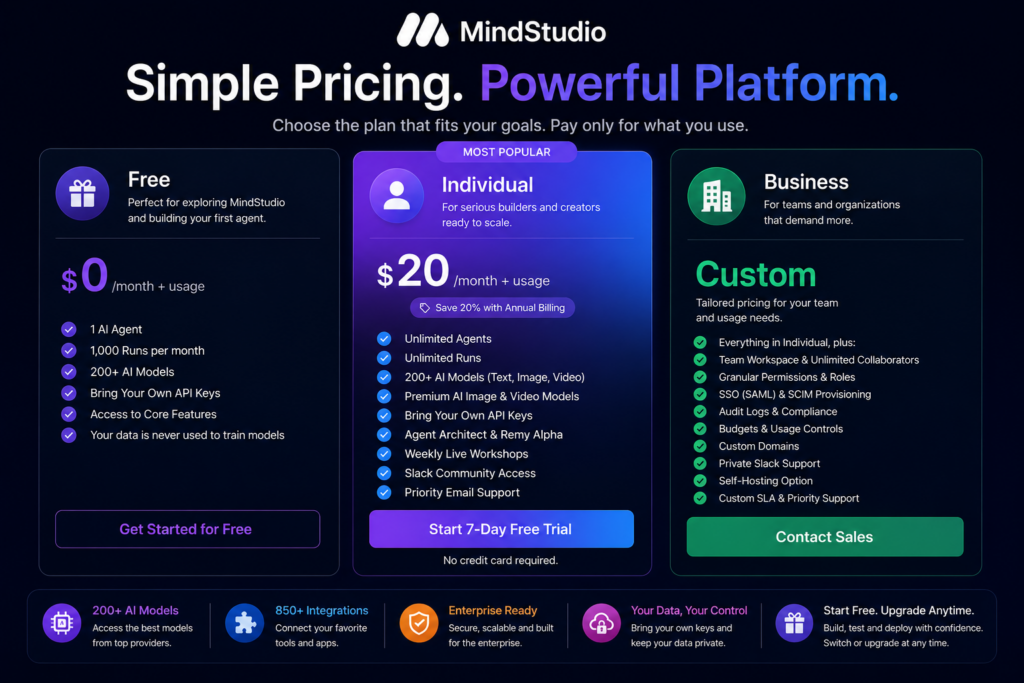
MindStudio Pricing: Free vs Individual vs Business
There’s One Pricing Detail You Should Understand
The subscription and AI model usage are not necessarily the same thing.
MindStudio provides access to models through its service infrastructure, but inference still has a cost.
The company states that model-provider costs are passed through without markup.
Alternatively, users can bring their own API keys.
MindStudio support clarified in February 2026 that when users provide their own API keys, those model calls are billed directly by the provider rather than consuming the MindStudio usage balance.
One exception is processing Data Sources for RAG, where uploaded content needs extraction, chunking and vectorization. MindStudio support stated that this processing costs $0.10 per million tokens at the time of that clarification.
This is useful to understand before comparing MindStudio’s $20 Individual subscription with another automation platform.
Privacy and Enterprise Control
AI workflow platforms often process business-sensitive information.
MindStudio states that user data is never used to train AI models.
For enterprise environments, MindStudio also offers private deployment options.
Businesses can self-host MindStudio so data stays within their own cloud or network environment.
Additional enterprise controls include:
- SAML SSO
- SCIM provisioning
- Role-based access
- Audit logging
- SLAs
- Dedicated support
Organizations can also connect their own models and databases.
What I Like About MindStudio
It Is Model-Agnostic
Access to 200+ models means you aren’t building your entire workflow around one AI vendor.
Agent Architect Lowers the Starting Barrier
Being able to describe an agent before manually refining the workflow makes agent building more approachable.
AI Is the Core, Not an Add-On
The platform was designed around AI-native workflows rather than adding an AI step to an older automation architecture.
RAG + Logic + Actions Live Together
You can combine knowledge retrieval, model reasoning, workflow logic and external actions in the same system.
Human Approval Is Supported
This makes the platform more appropriate for workflows where fully autonomous AI would be undesirable.
The New Agent Skills Ecosystem Is Ambitious
The combination of built-in actions, connector actions and model access could make MindStudio useful even when the primary agent lives outside MindStudio.
Individual Pricing Is Accessible
The $20/month Individual tier lowers the barrier for builders who want more than the Free plan.
What Could Be Better
MindStudio isn’t automatically the right automation tool for everyone.
There Is Still a Learning Curve
Agent Architect helps, but sophisticated AI workflows still require understanding logic, models, data and automation.
Usage Costs Are Separate
The subscription price isn’t necessarily your complete cost because model inference and certain processing operations have usage charges.
Traditional Automation May Be Simpler for Basic Workflows
If all you need is:
Form submission → Add row to spreadsheet → Send email
an AI-native agent platform may be unnecessary.
The Ecosystem Is Moving Quickly
MindStudio is actively adding features such as Remy and Agent Skills. That creates opportunity, but it also means users should verify current availability before designing critical production workflows around newer functionality.
Who Should Use MindStudio?
AI Builders
People who want to create agents without writing the entire orchestration layer themselves.
Entrepreneurs
Founders who want to prototype AI-powered business workflows quickly.
Agencies
Teams that repeatedly build AI automations for different clients.
Marketing Teams
Especially for research, content operations and competitive monitoring.
Operations Teams
For workflows involving classification, analysis, routing and repetitive information processing.
Developers
Developers who want AI infrastructure and integrations without manually maintaining every provider connection.
Businesses Exploring AI Agents
Organizations moving beyond isolated AI chat tools toward repeatable internal workflows.
Who Probably Doesn’t Need It?
MindStudio may be excessive if you:
- Only use AI for occasional questions
- Only need basic text generation
- Have extremely simple app-to-app automations
- Don’t need repeatable workflows
- Don’t need external actions or integrations
- Already have a mature custom agent infrastructure that your engineering team prefers to maintain
For these users, a standalone AI assistant or conventional automation tool may be simpler.
MindStudio Pros & Cons
| Pros | Cons |
|---|---|
| 200+ AI models | More complex than a basic chatbot |
| AI-native workflow builder | AI inference can add usage costs |
| Agent Architect | Advanced agents still require workflow thinking |
| Unlimited agents on Individual | Free plan has meaningful limitations |
| RAG support | Basic automations may not need it |
| Human-in-the-Loop | Newer features continue evolving |
| MCP support | |
| Multi-step reasoning | |
| Bring your own API keys | |
| AI image & video models | |
| Enterprise self-hosting | |
| Large action/integration ecosystem |
Is MindStudio Worth It?
MindStudio becomes interesting when you stop thinking about AI as a chatbot.
If your goal is simply:
“Write an email for me.”
you don’t need an AI-agent platform.
But if your goal is:
“When a new lead arrives, research the company, analyze whether it fits our ICP, create a sales brief, update our CRM and prepare a personalized follow-up for human approval.”
the problem is completely different.
Now you need:
AI + Data + Logic + Tools + Automation.
That’s where MindStudio makes sense.
Its combination of 200+ models, visual workflows, Agent Architect, RAG, MCP, human approval, deployment and increasingly broad agent capabilities gives builders a substantial amount of infrastructure without requiring them to construct every component from scratch.
Final Verdict
MindStudio is one of the more interesting platforms for users who want to move from using AI to building systems with AI.
Its strongest advantage isn’t any single model.
It’s orchestration.
You can choose different models, give agents knowledge, add reasoning steps, connect tools, introduce human approvals and deploy the resulting workflow.
For individual builders, the combination of a Free plan and a relatively accessible Individual tier makes experimentation easier.
For businesses, the more interesting features are governance, collaboration, private deployment and control over models and data.
And for developers, the growing Agent Skills ecosystem could make MindStudio useful even beyond agents created directly inside its visual builder.
Best For
AI automation builders, agencies, entrepreneurs, marketers, operations teams and businesses building repeatable AI workflows.
Main Strength
Turning AI models into agents that can actually perform multi-step work.
Biggest Consideration
Understand model usage costs and determine whether your workflow genuinely needs AI-native orchestration rather than conventional automation.
Build Your First MindStudio Agent
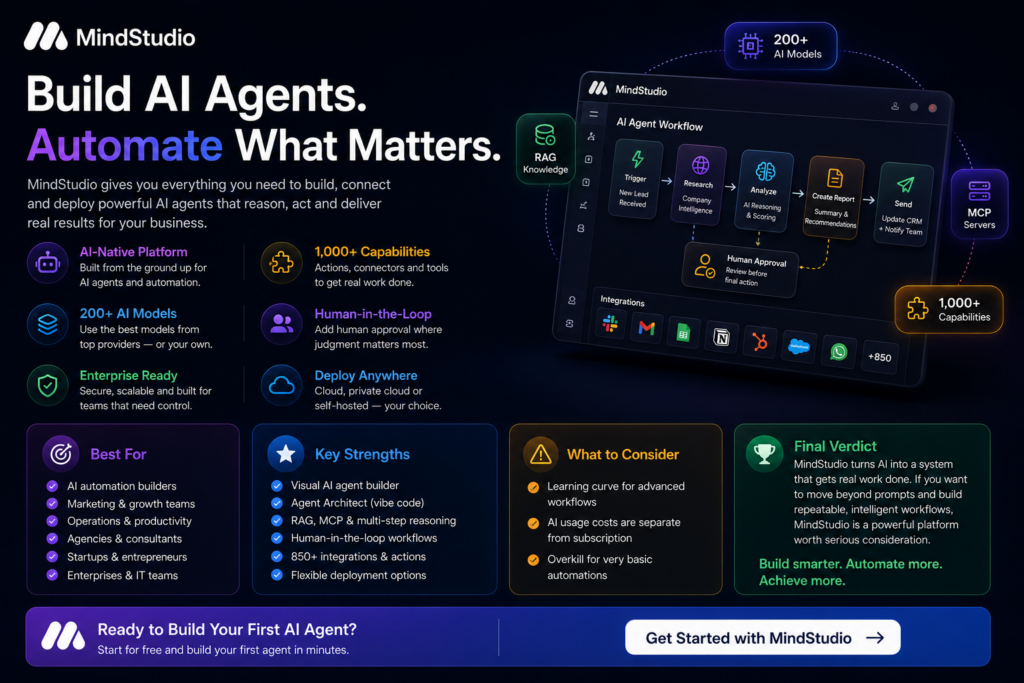
MindStudio Final Verdict: Who It’s For, Strengths & Considerations
Frequently Asked Questions
What is MindStudio?
MindStudio is an AI-native workflow automation platform for creating, deploying and managing AI agents. It combines AI models, data, logic and external actions into reusable workflows.
Does MindStudio require coding?
Not necessarily. MindStudio provides visual building tools and Agent Architect, which can scaffold an agent from a natural-language description. More sophisticated workflows still benefit from technical understanding.
How many AI models does MindStudio support?
MindStudio currently advertises access to more than 200 AI models, including models from OpenAI, Anthropic and Google.
Can I use my own API keys?
Yes. MindStudio supports bringing your own API keys.
Is MindStudio free?
MindStudio currently offers a Free plan at $0/month plus applicable usage, with one agent and up to 1,000 runs per month.
How much is MindStudio Individual?
The current monthly price is $20/month plus usage, with unlimited agents and unlimited runs. Annual billing is advertised with a 20% saving.
Does MindStudio support RAG?
Yes. Retrieval-Augmented Generation is listed among MindStudio’s platform capabilities.
Can MindStudio build AI agents?
Yes. AI-agent creation, deployment and management are central to the platform. Agent Architect can also help scaffold agents from natural-language instructions.
Can businesses self-host MindStudio?
MindStudio offers self-hosting as an enterprise deployment option for organizations requiring greater control over infrastructure and data.
Is MindStudio better than Zapier or n8n?
They have overlapping capabilities but different strengths. MindStudio is designed around AI-native agents and reasoning workflows, while traditional automation platforms can be simpler for deterministic app-to-app automations.
Conclusion
The biggest shift in AI isn’t simply that models are getting smarter.
It’s that those models are being connected to tools, data and workflows.
MindStudio is built around that transition.
Instead of asking you to manage dozens of separate AI and automation components, it provides an environment where models can reason, retrieve knowledge, execute actions and participate in repeatable workflows.
That makes it especially interesting for anyone asking:
“How do I turn AI from something I chat with into something that actually gets work done?”
For that use case, MindStudio deserves serious consideration in 2026.