Turning an idea into a working website or web application traditionally requires several steps.
You may need a designer to create the interface, a developer to write the code, backend infrastructure, authentication, hosting, integrations, payments, analytics, and ongoing technical maintenance.
Lovable is designed to dramatically simplify that process.
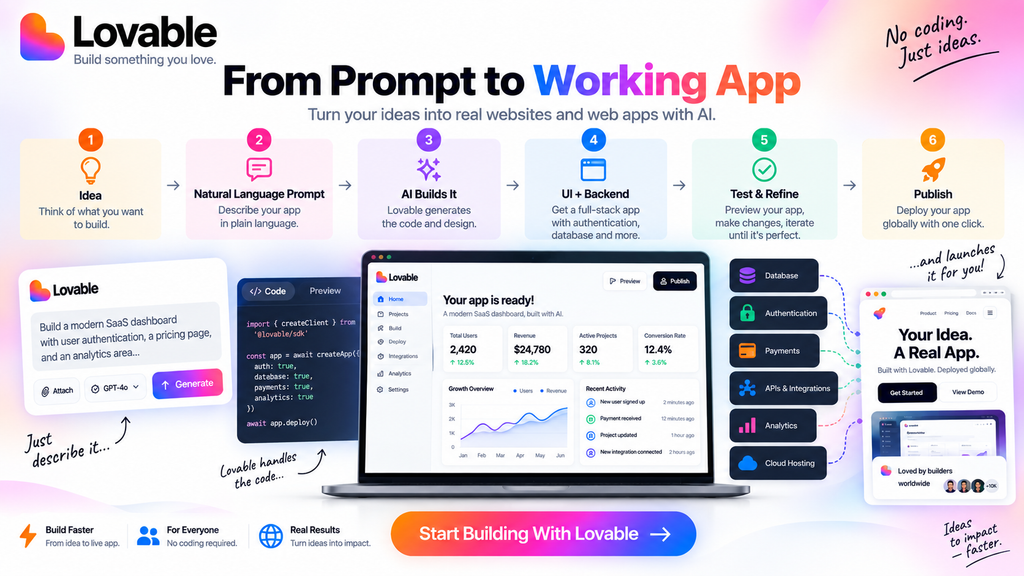
Lovable describes itself as an AI software engineer and AI app builder that lets users create websites and web applications simply by describing what they want in natural language. You can start with an idea, watch Lovable turn it into a functional prototype, refine it through additional prompts, and then deploy it.
The workflow is essentially:
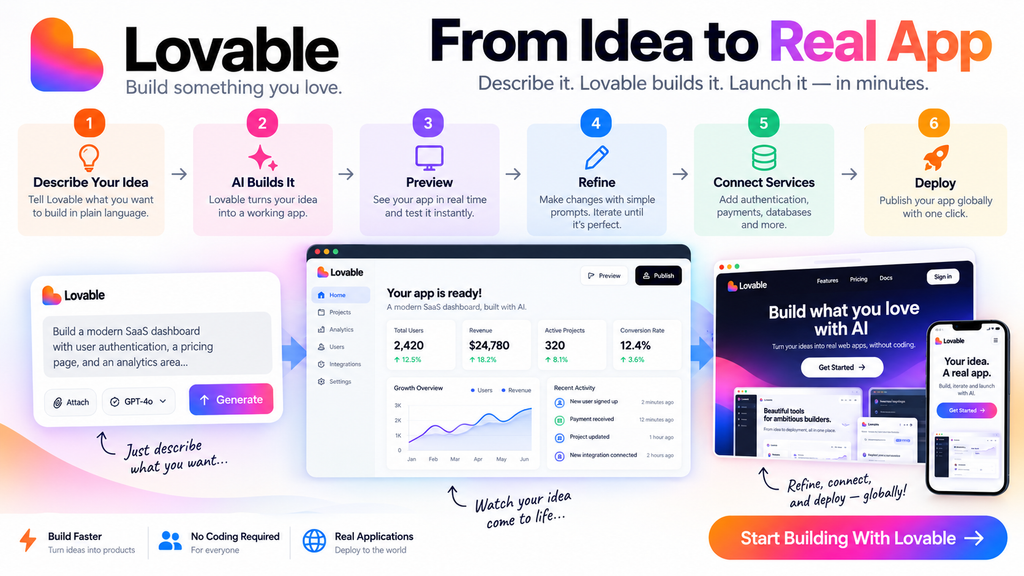
Describe Your Idea → AI Builds It → Preview → Refine → Connect Services → Deploy
Lovable goes beyond generating a static landing page. Its platform can handle infrastructure including hosting, authentication, payments, integrations, analytics, cloud functionality, security, SEO, and AI-related features.
But does that make Lovable a practical alternative to traditional development?
This Lovable review covers its AI app-building workflow, major features, Cloud capabilities, pricing, credits, advantages, limitations, and the types of users who may benefit most.
Lovable Review: Quick Verdict
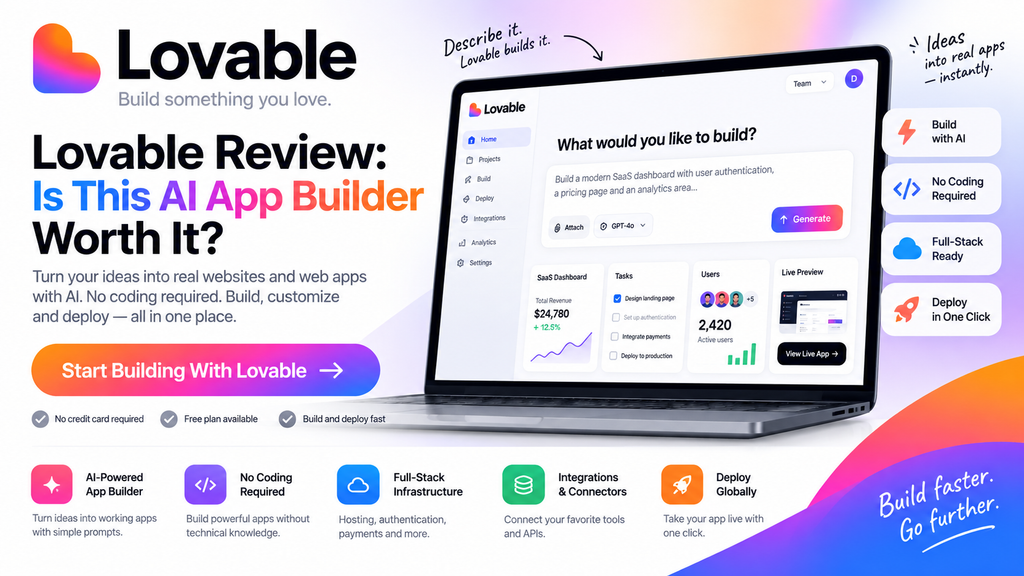
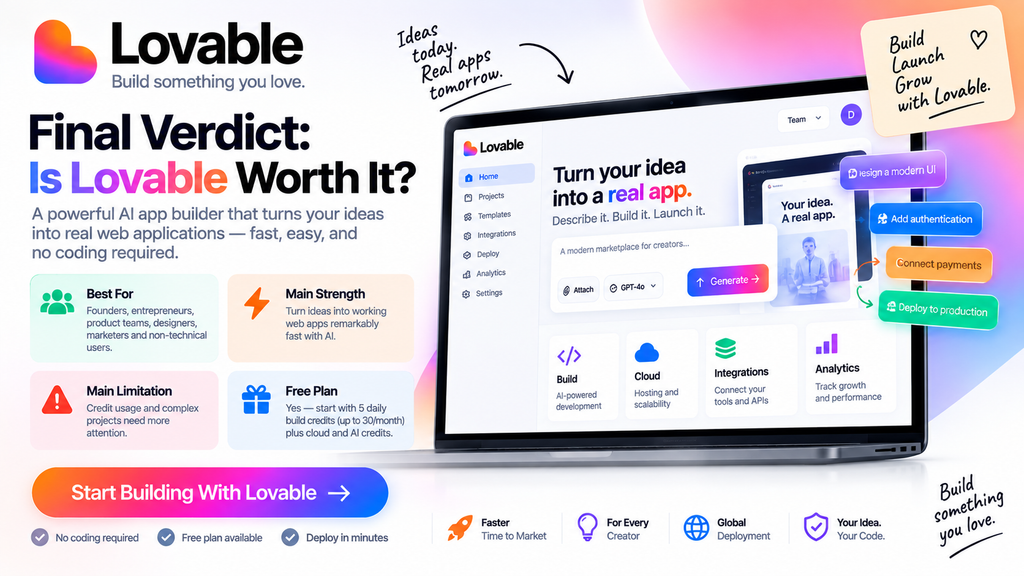
Best For: Founders, entrepreneurs, marketers, product teams, designers, startups, students, and non-technical users who want to turn ideas into working web products quickly.
Main Strength: You can describe what you want conversationally and have Lovable build a functioning web application in real time.
Main Limitation: The credit-based model means larger projects and frequent AI iterations require closer attention to usage.
Free Plan: Yes. Lovable currently provides 5 daily build credits, capped at 30 per month on the Free plan, plus separate Cloud and in-app AI grants.
Coding Required: Not necessarily. Lovable explicitly positions the product as usable without technical knowledge.
Code Ownership: Lovable says users own the code, apps, websites and other projects they create, subject to applicable third-party rights.
Verdict: Lovable is particularly compelling when speed from idea → prototype → deployed product matters more than manually coding every component yourself.
What Is Lovable?
Lovable is an AI-powered platform for building websites and web applications through conversation.
Instead of beginning with an empty code editor, you can explain what you want.
For example:
Build a modern SaaS dashboard with user authentication, a pricing page and an analytics area.
Lovable then translates those instructions into software.
Its current French homepage describes a three-stage process:
Start With an Idea → Watch It Come to Life → Refine and Publish.
You can also provide screenshots and documents to communicate what you want to create.
That makes Lovable interesting not only for developers, but also for people who understand the product they want without necessarily knowing how to implement it themselves.
1. Build Apps by Chatting With AI
Lovable’s defining feature is its conversational development experience.
You describe the product or change you want, and Lovable performs the implementation.
That can turn a traditional development workflow:
Idea → Wireframe → Design → Frontend → Backend → Testing → Deployment
into something closer to:
Idea → Prompt → Working Application → Feedback → Refinement → Deploy
Lovable says it builds production-grade software with users in real time.
The biggest benefit is speed.
You can focus more heavily on what the product should do rather than immediately worrying about every implementation detail.
2. From Prompt to Functional Prototype
Generating a beautiful screenshot is one thing.
Generating something users can actually interact with is considerably more useful.
Lovable focuses on creating functional web experiences rather than simply producing visual mockups.
Its own workflow describes watching an idea transform into a functional prototype in real time as the AI builds it.
This can be useful for:
- SaaS prototypes
- Internal tools
- Landing pages
- Business websites
- Dashboards
- Customer portals
- Online stores
- MVPs
- Interactive applications
The result can then be refined through additional instructions.
3. Full-Stack App Building
Lovable isn’t positioned purely as a frontend generator.
Its platform increasingly handles the infrastructure required to operate full-stack products.
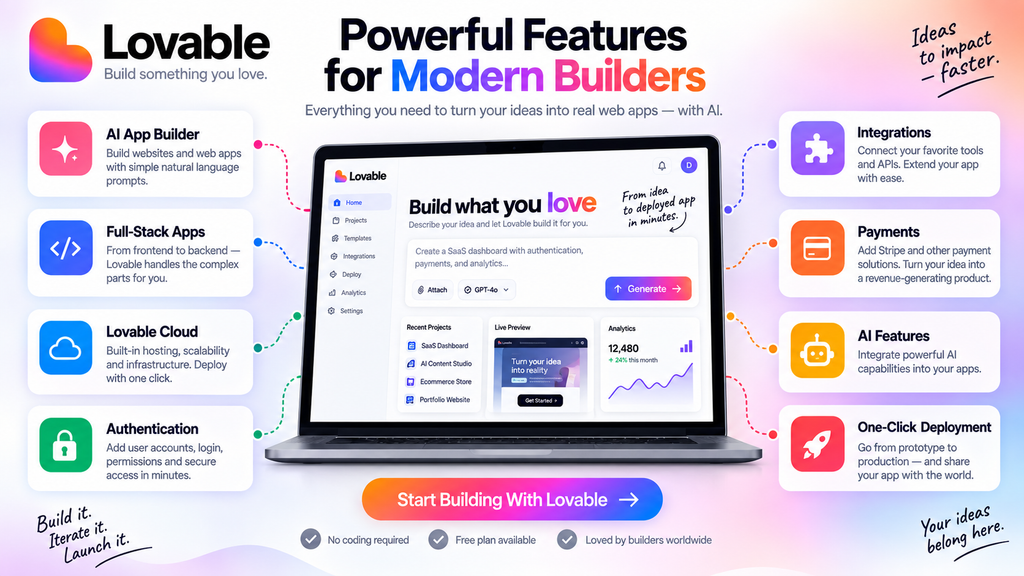
Lovable currently highlights:
Cloud • Analytics • Connectors • Security • Agent Integrations • Payments • SEO & AI Search.
It also says its end-to-end infrastructure can cover hosting, authentication, payments and integrations.
This matters because building the interface is only one part of shipping a real application.
4. Lovable Cloud
A web application needs somewhere to run.
Lovable integrates Cloud functionality into its broader platform, allowing users to build and run applications without independently assembling every infrastructure component.
Lovable’s current pricing model even combines Build, Cloud and AI usage around its credit system.
For smaller or newer applications, Lovable says hosting costs will often be minimal enough to fit within the included Cloud grant. Applications with significant traffic or size can consume additional credits.
That makes the transition from:
Prototype → Published App
considerably easier for beginners.
5. Authentication & User Accounts
Many web apps need more than public pages.
Users may need to:
Sign Up → Log In → Access Their Account → Store Data → Use Personalized Features
Lovable can implement authentication as part of the build process.
Its pricing documentation even uses adding authentication with signup and login as an example of a development request handled through Lovable’s credit system.
This helps distinguish it from simple AI website generators.
6. Integrations & Connectors
Modern applications rarely operate completely independently.
They may need payments, databases, external APIs, analytics, AI models, or other business services.
Lovable provides connectors and integrations as part of its development environment, while its main platform explicitly highlights Connectors and Agent integrations among its capabilities.
This allows more sophisticated products to be assembled without building every component from scratch.
7. Payments
Lovable can also support applications that need payment functionality.
Payments are included among the capabilities Lovable highlights for building and running products.
This makes Lovable relevant for projects such as:
SaaS Products • Membership Applications • Online Services • Paid Tools • Ecommerce Experiences
The ability to move from an idea to a monetizable product inside one development workflow is an important advantage.
8. AI Features Inside Your Apps
Lovable doesn’t only use AI to build applications.
Its credit system also supports AI functionality inside applications created by users.
Lovable’s pricing documentation separates credits used for:
Building → Cloud → AI features inside user applications.
That means a creator can potentially build an AI-enabled product rather than merely using AI during development.
Examples could include applications involving conversational interfaces, content processing, intelligent assistance, or other AI-driven workflows.
9. Templates
Not every project needs to start completely from scratch.
Lovable provides templates for different application and website concepts.
Its current template examples include ecommerce websites, moodboard applications, blogs, dashboards, habit trackers and even presentation-building experiences.
Templates can be especially useful when you know the type of product you want but don’t yet have a detailed design.
10. Refine With Natural-Language Feedback
One of Lovable’s biggest usability advantages is iteration.
After the initial application appears, you can continue telling Lovable what to change.
For example:
Change the layout.
Add authentication.
Remove the footer.
Create another dashboard page.
Modify the button styling.
Lovable’s pricing documentation shows that requests can consume different amounts of credits depending on their complexity. In Default Mode, credit usage varies by task; Plan Mode uses one credit per message.
This creates an iterative workflow similar to working with an AI development partner.
11. Deploy Your Application
Building a prototype isn’t particularly valuable if publishing it becomes another complicated engineering project.
Lovable emphasizes the ability to refine and deploy creations from within its workflow. Its French homepage specifically describes deploying the finished creation globally in one click.
That produces a much shorter path:
Idea → Build → Test → Refine → Publish
For founders testing new concepts, reducing that cycle from weeks to hours or days can be valuable.
Lovable Pricing
Lovable uses a credit-based pricing model.
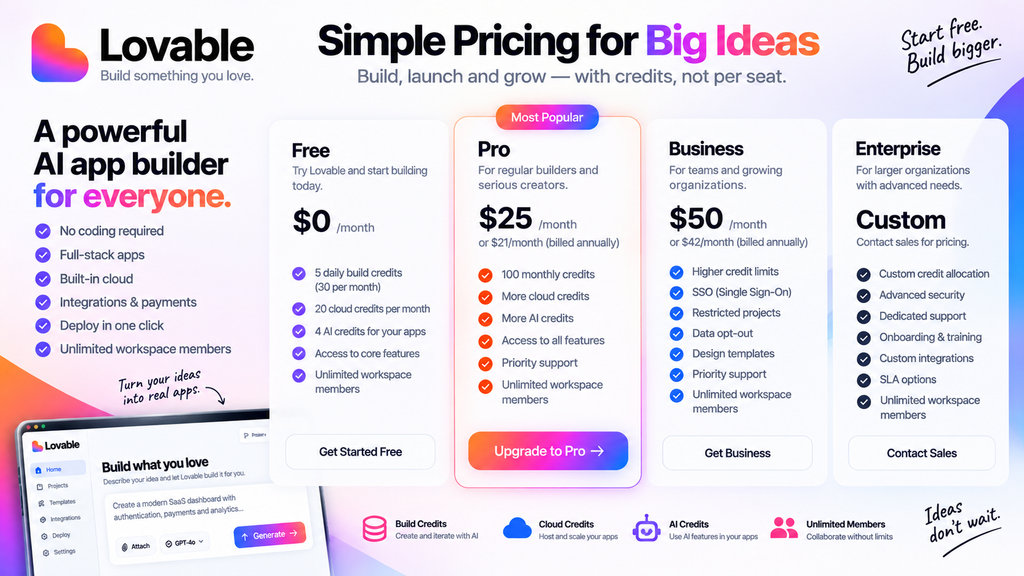
Rather than charging based on the number of team members, Lovable says workspaces support unlimited members across all plans and subscriptions are priced according to included credits.
The current primary structure includes:
| Plan | Starting Point | Best For |
|---|---|---|
| Free | $0 | Trying Lovable & small projects |
| Pro | $25/month | Regular builders |
| Business | $50/month | Teams & organizations |
| Enterprise | Custom | Larger organizations |
Lovable’s own recent comparison guide lists Pro at $25/month or $21/month billed annually, while Business is $50/month or $42/month billed annually. Pricing and included credits can change, so verify the live pricing page before purchasing.
Lovable Free Plan
One of Lovable’s strongest entry points is that you can start without paying.
The current Free plan provides:
5 daily build credits, subject to a maximum of 30 per month.
It also includes 20 Cloud credits per month and 4 credits for testing AI features inside user-built apps.
That makes the Free tier useful for understanding how Lovable works before deciding whether the AI development workflow suits you.
Lovable Pro
Pro is aimed at people who build more regularly.
Lovable’s current comparison guide lists the starting Pro package at 100 monthly credits, in addition to daily build credits.
For freelancers, founders, product builders and frequent users, Pro provides substantially more room to iterate than the Free plan.
Lovable Business
Business targets teams and organizations needing additional controls.
Lovable’s current comparison material highlights Business features such as:
- SSO
- Restricted projects
- Data opt-out
- Design templates
The underlying workspace model remains particularly interesting because Lovable does not charge per seat. Everyone invited to a workspace shares its credit pool.
How Lovable Credits Work
Understanding credits is important before subscribing.
Credits can cover three broad areas:
Build – requests you send while creating or modifying software.
Cloud – resources used to run applications.
AI – AI functionality used inside the applications you create.
Not every prompt necessarily costs the same amount.
For example, Lovable currently illustrates that a small visual change can consume less than one credit, while more involved functionality such as authentication can consume more.
This makes efficient prompting and planning increasingly important on larger projects.
Lovable Pros and Cons
Pros
Extremely Fast Prototyping: Turn an idea into an interactive web product much faster than building everything manually.
No Technical Knowledge Required to Start: Lovable explicitly targets users who can describe what they want even without coding knowledge.
Natural-Language Development: Building and modifying software feels conversational.
Full-Stack Direction: Lovable handles more than UI generation, including infrastructure, authentication, integrations and payments.
Built-In Deployment: You can move from creation to a published application without assembling an entirely separate deployment stack.
Free Plan: You can experiment before purchasing.
Code Ownership: Lovable says the code and projects you create belong to you, subject to applicable third-party rights.
Unlimited Workspace Members: Pricing is credit-based rather than seat-based.
Lovable Cons
Credits Require Management: Frequent iterations can consume your available balance.
Complex Apps Still Require Thinking: AI can write software, but users still need to clearly define requirements, workflows and expected behavior.
Generated Software Still Needs Testing: AI-generated functionality should be reviewed before relying on it for important production workflows.
Free Usage Is Limited: The Free tier is excellent for experimentation, but regular building will likely require more capacity.
Large Projects Can Become More Complex: As an application expands, architecture, security, data, integrations and maintenance matter more.
Who Is Lovable Best For?
Founders
Lovable can dramatically shorten the journey from product concept to working MVP.
Non-Technical Entrepreneurs
You don’t need to begin by hiring a full development team just to test whether an idea works.
Product Managers
Product concepts can become interactive prototypes rather than remaining static documents or wireframes.
Designers
Designers can move closer to working software while retaining a conversational iteration process.
Marketers
Lovable can create landing pages, internal tools, campaign experiences and other web applications without a traditional development cycle.
Developers
Experienced developers can also use Lovable to accelerate initial implementation and repetitive development work.
Lovable vs Traditional Development
| Workflow | Lovable | Traditional Development |
|---|---|---|
| Start From Natural Language | ✅ | ❌ |
| AI Generates Application | ✅ | ❌ |
| Functional Prototype | Fast | Usually Slower |
| Authentication | Can Be Generated | Manually Implemented |
| Hosting | Integrated | Separate Setup |
| Payments | Supported | Separate Integration |
| Iteration | Prompt-Based | Code Changes |
| Deployment | Integrated | DevOps/Platform Setup |
| Coding Knowledge | Optional to Start | Usually Required |
Lovable doesn’t eliminate the value of professional software engineering.
Instead, it changes how quickly someone can get from an idea to something real.
Is Lovable Worth It?
For prototyping, Lovable’s value proposition is strong.
Imagine wanting to test a SaaS idea.
Traditionally, you might spend considerable time on:
Wireframes → UI Design → Frontend → Backend → Authentication → Hosting → Deployment
Lovable compresses much of that process into:
Describe → Generate → Test → Refine → Publish
That doesn’t mean every application will instantly be production-ready.
Complex products still require careful thinking about security, data architecture, business logic and testing.
But for turning ideas into working software quickly, Lovable offers a fundamentally different workflow.
The Free plan also means you can evaluate that workflow before committing to a paid subscription.
Frequently Asked Questions
What Is Lovable?
Lovable is an AI software engineer and app-building platform that lets users create websites and web applications through natural-language conversation.
Is Lovable Free?
Yes. Lovable currently offers a Free plan with daily build credits and additional Cloud and AI grants.
Do I Need to Know How to Code?
Not necessarily. Lovable says users can create websites and applications without technical knowledge by describing what they want.
Can Lovable Build Full-Stack Apps?
Lovable positions its platform for full-stack software and provides infrastructure covering areas such as hosting, authentication, payments and integrations.
Who Owns the Code Created With Lovable?
Lovable says you own the code and projects you create, subject to applicable third-party rights relating to underlying AI models.
Does Lovable Charge Per User?
No. Lovable says its workspaces support unlimited members, with pricing based on credits rather than seats.
Can I Publish Apps Built With Lovable?
Yes. Lovable’s workflow is designed to let users build, refine and deploy applications.
Final Verdict: Should You Use Lovable?
Lovable represents one of the clearest examples of how AI is changing software development.
Instead of starting with code, you start with an idea.
Describe → Build → Refine → Deploy
Its combination of AI-generated software, full-stack infrastructure, Cloud, authentication, payments, integrations, analytics, deployment and AI capabilities means it can take a project much further than a simple AI page generator.
Best For: Founders, entrepreneurs, product teams, designers, marketers and people who want to build web products quickly.
Main Strength: Turning natural-language ideas into functional web applications remarkably quickly.
Main Limitation: Credit usage and application complexity need more attention as projects grow.
Free Plan: Yes.
Final Verdict: Lovable is worth trying if your biggest obstacle is turning an idea into working software. Its Free plan makes experimentation easy, while Pro and Business provide additional capacity for people and teams building more seriously.