Collecting reliable web data at scale can quickly become complicated. Websites change, data comes in different formats, infrastructure requires maintenance, and turning raw information into something useful for AI or analytics often requires additional engineering.
This is where Bright Data comes in.
Bright Data is a web data platform built for developers, AI teams, businesses, researchers, and organizations that need scalable access to publicly available web information.
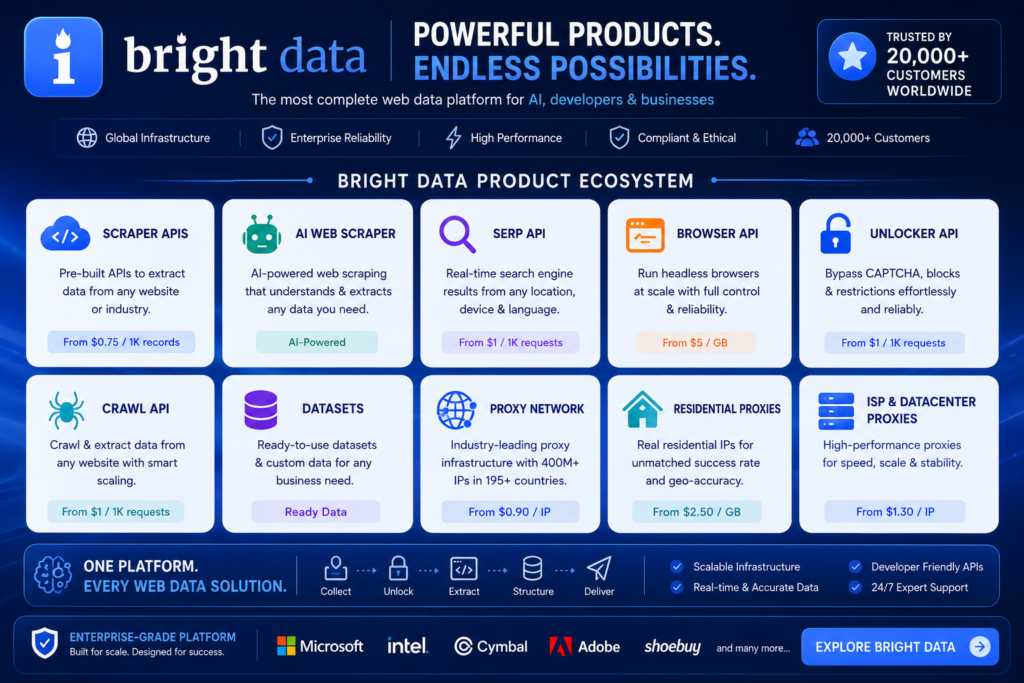
Rather than offering only proxies, Bright Data combines web scraping APIs, proxy infrastructure, datasets, browser-based tools, SERP data, crawling technology, and AI-ready web data solutions within a broader ecosystem.
But is Bright Data actually worth using in 2026?
In this Bright Data review, we’ll examine its major features, web scraping capabilities, AI applications, proxy infrastructure, pricing, advantages, disadvantages, and ideal users.
Quick Verdict: 4.8/5
Best For: AI developers, SaaS companies, SEO platforms, data teams, eCommerce businesses, researchers, and enterprise organizations.
What Is Bright Data?
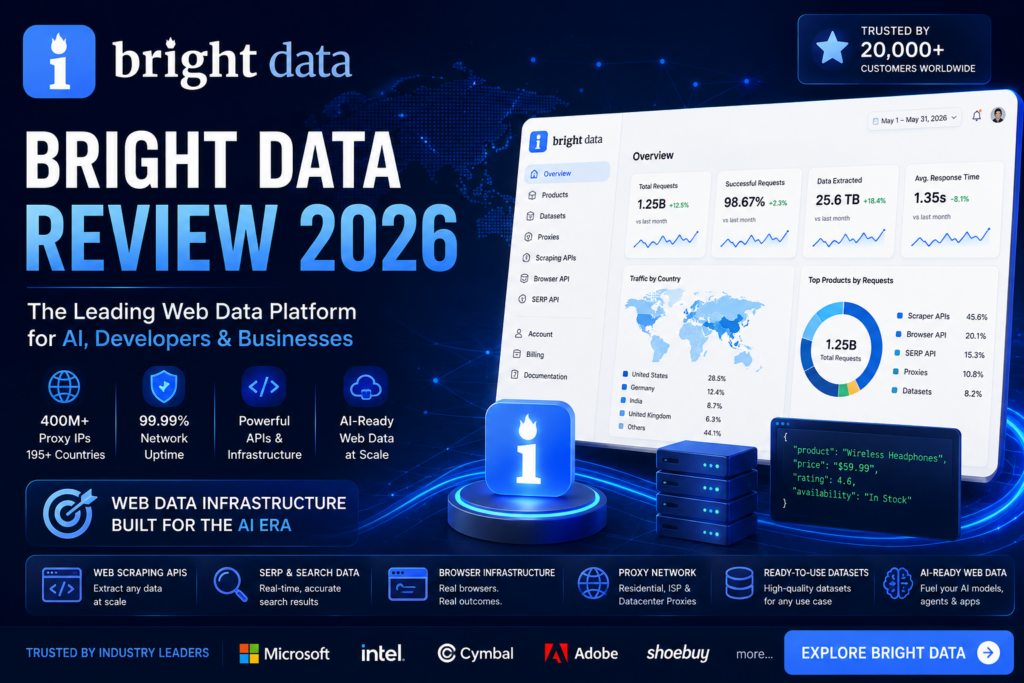
Bright Data is a web data infrastructure platform that helps organizations access, collect, structure, and use publicly available information from the web.
The company is widely known for its proxy infrastructure, but its product ecosystem has expanded considerably.
Today, Bright Data offers solutions covering areas such as:
- Web Scraping APIs
- AI Web Scraping
- SERP API
- Browser API
- Crawl API
- Web Unlocker
- Residential proxies
- ISP proxies
- Datacenter proxies
- Ready-made datasets
- Custom datasets
- AI-ready web data
The idea behind the platform is relatively straightforward.
Instead of requiring developers to create every component of a large-scale web data pipeline themselves, Bright Data provides much of the infrastructure required to collect and transform web information.
For businesses, this can reduce the engineering resources required to build and maintain complex data-collection systems.
For AI developers, it can provide a bridge between the live web and applications that require fresh, structured information.
How Does Bright Data Work?
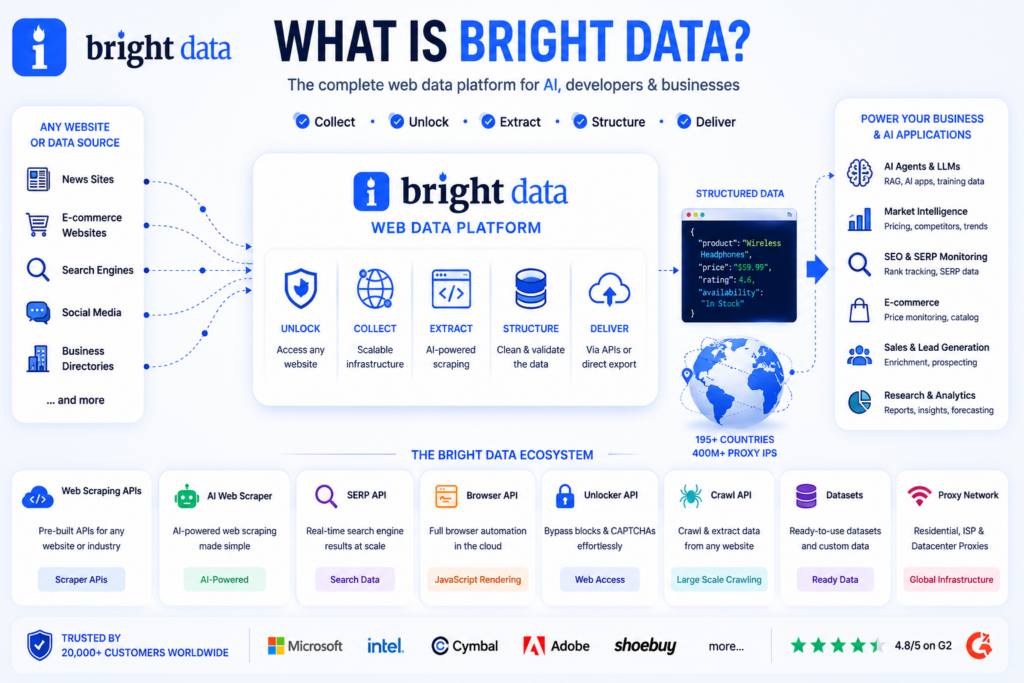
Bright Data provides several ways to access web information depending on what you are building.
A typical workflow might look something like this:
Website → Bright Data Infrastructure → Data Extraction → Structured Data → Application
For example, an eCommerce analytics platform could collect publicly available product information, transform that information into structured records, store it in a database, and then analyze price movements.
An AI application might use a similar process:
Web → Bright Data → Structured Information → RAG/AI Agent → User
The exact architecture depends on which Bright Data product you choose.
This flexibility is important because a developer building a simple SERP monitoring tool has very different requirements from an enterprise collecting millions of records for large-scale market intelligence.
Bright Data Key Features
Bright Data offers a large product ecosystem, so understanding its main features is important before deciding whether the platform fits your workflow.
1. Web Scraper APIs
One of the most important parts of Bright Data is its web scraping infrastructure.
Building a web scraper yourself may sound simple at first.
For small projects, it sometimes is.
However, larger projects quickly introduce additional technical challenges such as:
- Dynamic JavaScript pages
- Changing page structures
- Data validation
- IP management
- Scaling requests
- Parsing information
- Infrastructure maintenance
- Delivering structured output
Bright Data’s Scraper APIs are designed to handle much of this infrastructure.
Instead of focusing on every technical layer of data extraction, developers can focus more heavily on how the resulting information is used inside their applications.
This can make the service particularly attractive for teams that want to launch data products without building a complete scraping infrastructure internally.
Who could benefit?
Scraper APIs may be useful for:
- eCommerce intelligence
- Market research
- Product monitoring
- Travel data
- Real estate research
- Financial research
- Social data analysis
- Competitive intelligence
- AI applications
2. AI Web Scraper
The rise of generative AI has created enormous demand for current, structured web information.
Large language models can be powerful, but many applications need information that is newer or more specialized than what is available within a model’s existing knowledge.
Bright Data addresses this problem with web-data infrastructure designed for AI workflows.
Its AI-focused scraping tools can help convert web pages into information that downstream applications can process more easily.
A simplified workflow could look like:
Public Web Data
↓
Bright Data
↓
Structured Information
↓
Vector Database / Knowledge Base
↓
LLM or AI Agent
↓
Application
This makes Bright Data particularly relevant to developers building RAG systems and AI agents.
3. Bright Data for AI Agents
AI agents are becoming an increasingly important category of software.
Unlike a basic chatbot that primarily generates responses, an agent may need to interact with external information sources before completing a task.
For example, an AI agent might need to:
- Research products
- Compare publicly available prices
- Find market information
- Analyze competitors
- Collect search results
- Research companies
- Gather current web information
For these applications, reliable access to web data becomes part of the infrastructure behind the AI system.
Bright Data can function as that data-access layer.
Rather than forcing developers to build separate scraping systems for every data source, they can integrate web-data services into their agent architecture.
This is one reason Bright Data is increasingly relevant beyond the traditional proxy market.
4. SERP API
Search engine information is extremely valuable for SEO, marketing, competitive intelligence, and analytics.
Bright Data’s SERP API is designed to help applications retrieve search engine results programmatically.
Potential use cases include:
- Keyword rank tracking
- Competitor monitoring
- Local SEO analysis
- Search result analysis
- Market research
- Search trend monitoring
- SEO SaaS platforms
For example, an SEO software company could use SERP data as one component of its ranking-monitoring infrastructure.
Instead of manually checking thousands of keywords, the system can collect the relevant search information automatically and process it at scale.
For agencies, marketers, and SEO technology companies, this can be significantly more practical than manual SERP research.
5. Browser API
Some modern websites rely heavily on JavaScript.
This can make simple HTTP-based data collection insufficient.
Bright Data’s browser infrastructure is designed for workflows that require browser-level interaction and rendering.
This can be valuable when dealing with:
- JavaScript-heavy pages
- Dynamic content
- Interactive websites
- Modern web applications
- Browser-based automation
For developers, managed browser infrastructure can reduce the amount of browser automation infrastructure that needs to be maintained internally.
6. Web Unlocker
Another important part of Bright Data’s ecosystem is its web access technology.
Large-scale web data collection frequently requires infrastructure capable of managing requests reliably across different websites and environments.
Web Unlocker is designed to simplify this layer.
Rather than manually handling many networking and access-related components, developers can send requests through Bright Data’s infrastructure.
For teams collecting information across many websites, this can reduce engineering complexity.
7. Bright Data Datasets
Not every company wants to build a scraping pipeline.
Sometimes you simply need the data.
This is where Bright Data’s datasets become particularly interesting.
Instead of collecting information yourself, organizations can access datasets that have already been collected and structured.
Depending on availability, datasets can cover areas such as:
- eCommerce
- Companies
- Jobs
- Real estate
- Social platforms
- Business information
- Market intelligence
This can be especially valuable for AI companies.
Training models, building recommendation systems, developing analytics platforms, and creating RAG applications can all require significant quantities of structured information.
Buying or accessing an existing dataset can sometimes be faster than building the entire collection pipeline yourself.
8. Bright Data Proxy Network
Bright Data originally became widely recognized for its proxy network, and proxies remain an important part of its infrastructure.
The platform provides several proxy categories.
Residential Proxies
Residential proxies route traffic through residential IP addresses.
They are commonly used in legitimate web data applications requiring geographic coverage and residential network access.
ISP Proxies
ISP proxies combine characteristics associated with ISP-issued addresses and proxy infrastructure.
They can be useful when stability and longer sessions are important to a particular workflow.
Datacenter Proxies
Datacenter proxies are generally focused on speed, scalability, and cost efficiency.
They may be suitable for applications where residential IP characteristics are unnecessary.
The right option depends heavily on the project.
Bright Data’s advantage is that these products exist inside the same broader web-data ecosystem.
Bright Data for AI Development
This is arguably one of the most interesting reasons to consider Bright Data in 2026.
AI systems increasingly need information beyond static model knowledge.
Consider an AI shopping assistant.
The model itself can understand a question such as:
“Find the best laptop options for my requirements.”
But answering with current information may require access to:
- Current products
- Current prices
- Product specifications
- Availability
- Reviews
- Market information
A web-data layer can collect that information before the model analyzes it.
The workflow becomes:
User Question → AI Agent → Bright Data → Web Information → LLM Analysis → Answer
Similar architectures can be applied to:
- Shopping assistants
- Travel agents
- Financial research tools
- Competitive intelligence
- Recruitment platforms
- Sales intelligence
- Real estate applications
- Market research agents
This gives Bright Data an important position in the growing AI infrastructure market.
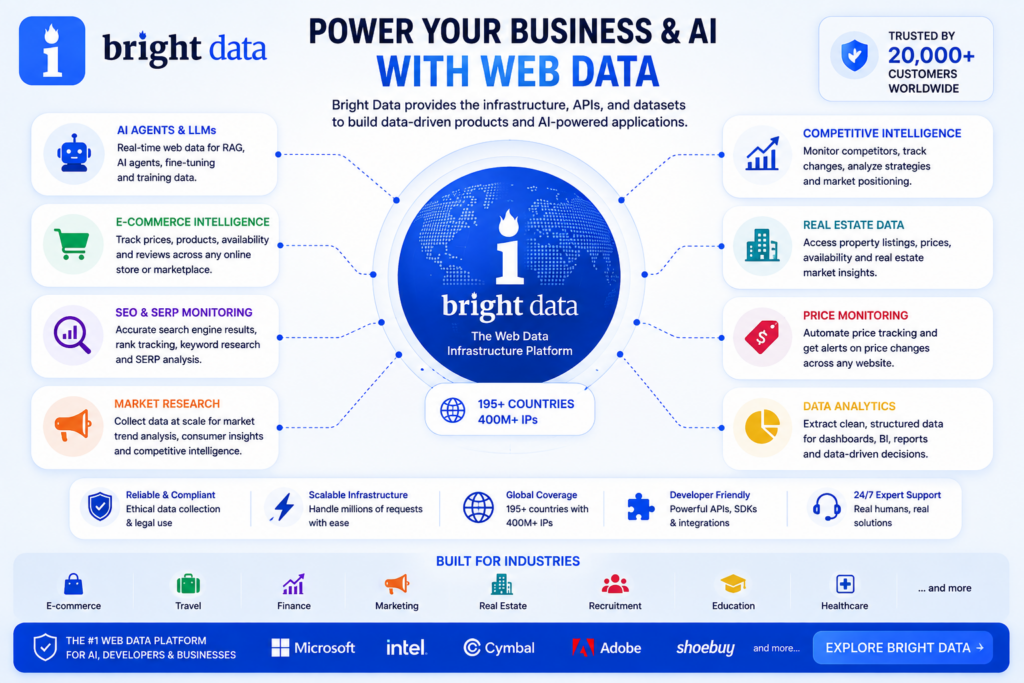
Bright Data for eCommerce
eCommerce is another strong use case.
Retailers and analytics companies may need to monitor large amounts of publicly available market information.
Potential applications include:
Price Intelligence
Track publicly listed prices across online stores and marketplaces.
Product Research
Analyze products, categories, specifications, and market positioning.
Competitive Intelligence
Understand how competing brands position products across different markets.
Market Analysis
Study category changes and product availability.
Review Analysis
Collect publicly available review information for broader sentiment and market research.
For large eCommerce organizations, automated data collection can be substantially more scalable than manual research.
Bright Data for SEO
SEO teams and software companies can also use web data infrastructure in several ways.
Possible workflows include:
- SERP monitoring
- Keyword ranking analysis
- Competitor research
- Local search analysis
- Search result tracking
- Market intelligence
This is especially useful for companies building SEO software.
A rank-tracking SaaS platform, for example, needs reliable search data continuously rather than occasionally.
Bright Data’s SERP infrastructure can become part of the backend powering that functionality.
Bright Data for Market Research
Traditional market research often relies on surveys, reports, and manually collected information.
Web data introduces another valuable information source.
Companies can analyze publicly available online information to understand:
- Competitor activity
- Product positioning
- Pricing
- Customer trends
- Market availability
- Business information
- Industry changes
When combined with analytics and AI, this can turn large quantities of web information into actionable business intelligence.
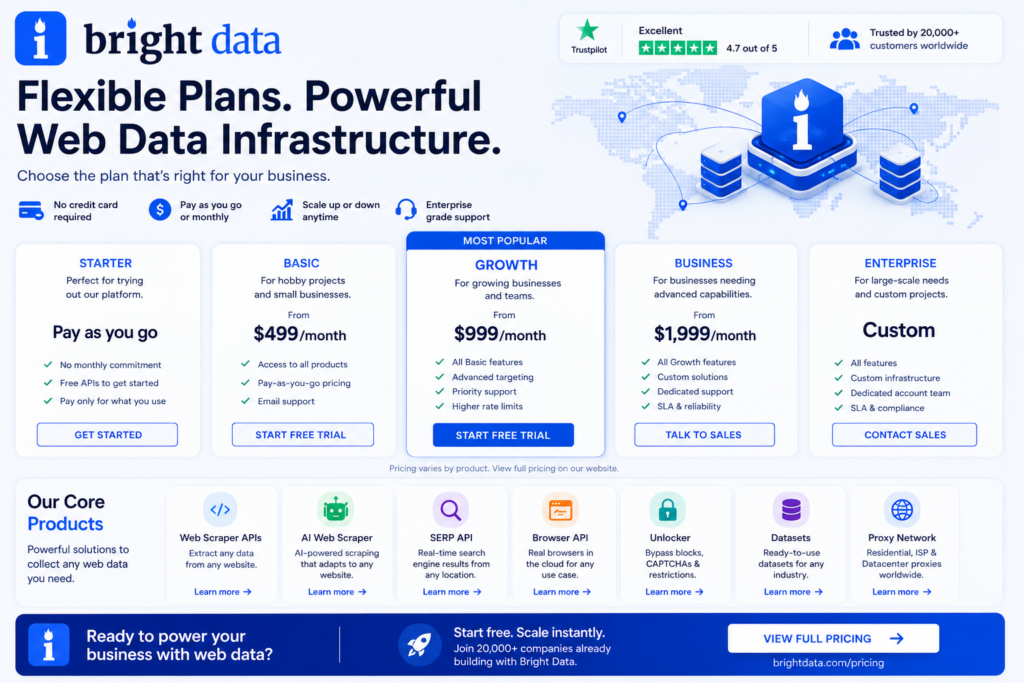
Bright Data Pricing
Bright Data does not have one universal price because it offers several different product categories.
Pricing depends on the service and usage level.
Products may use models based on:
- Requests
- Records
- Bandwidth
- IPs
- Data volume
- Subscription plans
For example, Bright Data currently presents different starting pricing structures across products such as Scraper APIs, SERP API, Browser API, Residential Proxies, ISP Proxies, and Datacenter Proxies.
Because prices and promotional offers can change, I recommend checking the current pricing directly before purchasing.
👉 Check Current Bright Data Pricing
Is Bright Data expensive?
That depends entirely on the project.
For someone who needs to collect a tiny amount of information occasionally, Bright Data may offer more infrastructure than necessary.
For a SaaS company or enterprise, however, the calculation is different.
You should compare Bright Data’s cost against the cost of:
- Building internal scraping systems
- Maintaining proxy infrastructure
- Managing browsers
- Updating scrapers
- Processing data
- Monitoring failures
- Scaling servers
- Maintaining engineering resources
In that context, paying for managed infrastructure can potentially be more efficient than maintaining everything internally.
Bright Data Pros and Cons
No platform is perfect, and Bright Data is no exception.
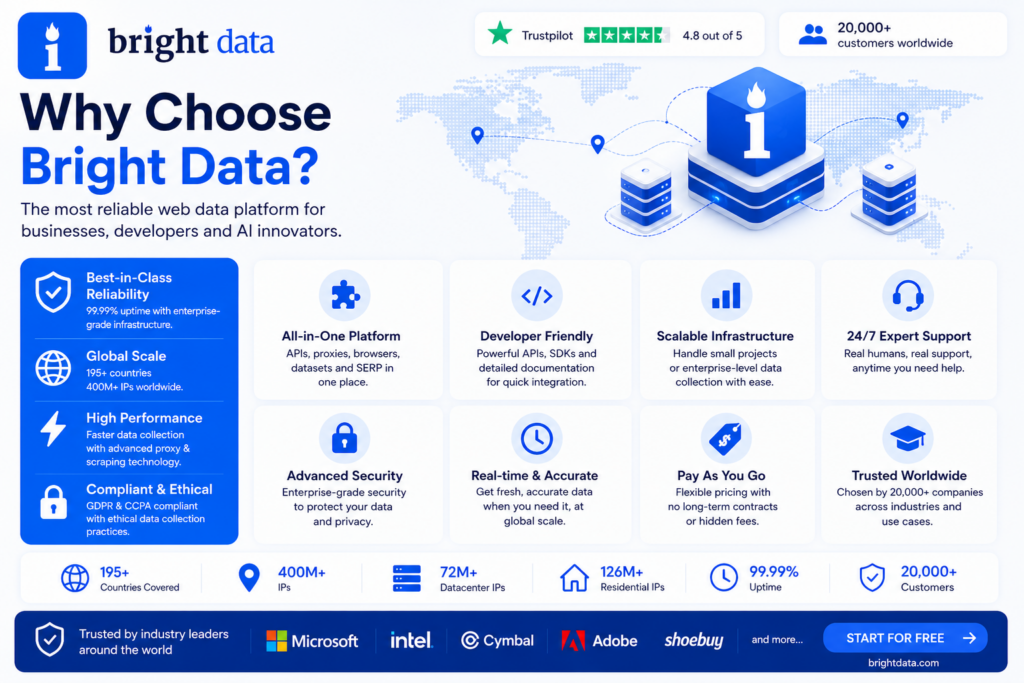
Pros
Comprehensive Web Data Ecosystem
Bright Data combines proxies, scraping APIs, datasets, browser infrastructure, SERP data, and AI-focused tools within one ecosystem.
Strong AI Use Cases
The platform fits naturally into modern AI workflows involving RAG, agents, data enrichment, and real-time web information.
Scalable
Bright Data can support projects ranging from developer experiments to enterprise data infrastructure.
Multiple Data Collection Options
Businesses can choose APIs, proxy infrastructure, or ready-made datasets instead of being forced into one approach.
Global Infrastructure
Its worldwide network makes Bright Data particularly relevant to projects requiring international coverage.
Developer-Friendly Integrations
APIs allow Bright Data services to become part of larger applications and automated workflows.
Cons
Learning Curve
Bright Data offers many products, which can initially make the platform feel complicated.
Pricing Requires Planning
Large data projects should estimate expected usage carefully.
Potentially Excessive for Simple Tasks
Users who only need a small amount of data may not require an infrastructure platform this comprehensive.
Bright Data vs Building Your Own Scraping Infrastructure
One of the biggest questions is whether you should use Bright Data or build everything yourself.
Building internally provides greater control.
But it also means your team may need to maintain:
- Proxy infrastructure
- Browser automation
- Scrapers
- Data parsers
- Servers
- Error handling
- Monitoring
- Scaling
- Data pipelines
This can make sense for companies with specialized requirements and significant engineering resources.
Bright Data takes a different approach.
It provides much of that infrastructure as a service.
The trade-off is straightforward:
Build Yourself: More control, more maintenance.
Bright Data: Less infrastructure management, ongoing service cost.
For many startups and SaaS teams, development speed can be more valuable than owning every infrastructure component.
Is Bright Data Easy to Use?
This depends on your technical background.
Bright Data is not primarily designed like a simple consumer AI tool where you create an account and start chatting.
It is infrastructure.
Developers and technical teams are therefore likely to get the most value from the platform.
However, Bright Data has increasingly packaged complex data infrastructure into APIs and managed services.
That lowers the technical barrier compared with building equivalent systems entirely from scratch.
Beginners should expect some learning time, particularly when deciding which Bright Data product best matches their use case.
Who Should Use Bright Data?
Bright Data is particularly well suited to several types of users.
AI Developers
For building AI agents, RAG applications, AI research tools, and systems that require current web information.
SaaS Companies
For integrating web information into software products without maintaining every collection component internally.
eCommerce Companies
For pricing intelligence, product research, competitive analysis, and market monitoring.
SEO Platforms
For SERP tracking, ranking analysis, and search intelligence.
Data Teams
For large-scale collection, transformation, and analysis of web information.
Researchers
For projects that require structured publicly available web information.
Enterprise Organizations
For companies that need scalable infrastructure and large data volumes.
Who Might Not Need Bright Data?
Bright Data will not be necessary for everyone.
You may want a simpler solution if:
- You only collect a few pages manually
- You don’t need automation
- Your project has very low data requirements
- You don’t need global web access
- You don’t need structured datasets
- You aren’t building a data-driven application
In those situations, a smaller scraping tool may be easier and more economical.
Bright Data becomes much more compelling as the scale and complexity of a project increase.
Is Bright Data Legit?
Yes. Bright Data is an established web data company used by businesses and organizations worldwide.
As with any web-data technology, customers are responsible for ensuring their own collection and processing activities comply with applicable laws, contractual requirements, and privacy obligations.
Bright Data also emphasizes compliance and responsible web-data collection across its platform.
For businesses handling significant volumes of data, these considerations should be part of the implementation process from the beginning.
Is Bright Data Worth It in 2026?
For professional web data applications, Bright Data is a compelling platform.
Its biggest strength is the breadth of its ecosystem.
You aren’t simply buying access to proxies.
You can combine:
Web Access + Scraping + Structured Data + Datasets + AI Infrastructure
under one platform.
This is particularly valuable as AI applications become more dependent on fresh information from outside the model itself.
AI agents need data.
RAG systems need information sources.
Analytics applications need structured records.
SEO platforms need search information.
eCommerce tools need product and pricing data.
Bright Data provides infrastructure that can sit behind many of these applications.
Bright Data Review: Final Verdict
After reviewing its major features, Bright Data earns a strong recommendation for developers and organizations that require professional web-data infrastructure.
Overall Rating: 4.8/5
Web Data Capabilities: 4.9/5
AI & RAG Potential: 4.9/5
Proxy Infrastructure: 4.9/5
Scalability: 4.9/5
Ease of Use: 4.4/5
Value for Professional Teams: 4.8/5
What We Like Most
- Powerful web scraping infrastructure
- Strong AI and RAG applications
- Multiple APIs
- Global proxy infrastructure
- Ready-made datasets
- Enterprise scalability
- Broad range of use cases
Main Drawbacks
- Can be complex for beginners
- Costs require planning at large scale
- Smaller projects may not need all of its capabilities
Best For: AI developers, SaaS companies, data teams, eCommerce businesses, SEO platforms, researchers, and enterprises.
If your application depends on reliable and scalable web information, Bright Data deserves a place on your shortlist.
Frequently Asked Questions
What is Bright Data used for?
Bright Data provides infrastructure for accessing, collecting, and structuring publicly available web information. Common applications include AI development, web scraping, market research, eCommerce intelligence, SERP monitoring, datasets, and business analytics.
Is Bright Data good for AI?
Bright Data can be particularly useful for AI applications that require fresh external information. Its web-data infrastructure can support AI agents, RAG systems, data enrichment, research tools, and other data-driven AI applications.
Does Bright Data offer proxies?
Yes. Bright Data provides several proxy products, including residential, ISP, and datacenter proxy infrastructure.
Does Bright Data offer web scraping APIs?
Yes. Bright Data offers scraping and web-access products designed to simplify large-scale web-data collection.
Can Bright Data be used for SEO?
Yes. Its SERP and web-data infrastructure can support applications such as rank tracking, search analysis, competitor monitoring, and SEO software.
Is Bright Data suitable for beginners?
It can be used by beginners, but the platform is primarily aimed at developers, businesses, and professional data teams. New users may need time to understand which product best fits their requirements.
Is Bright Data worth the money?
For businesses that need scalable web data, managed infrastructure can reduce the cost and engineering effort associated with building and maintaining an equivalent system internally. Very small projects may be better served by simpler alternatives.
Conclusion
Bright Data has evolved from a well-known proxy provider into a much broader web data and AI infrastructure platform.
Its combination of scraping APIs, SERP data, browser infrastructure, proxy networks, datasets, and AI-focused web-data solutions makes it especially relevant in 2026.
For small manual research projects, the platform may be more powerful than necessary.
But for AI developers, SaaS companies, SEO platforms, eCommerce businesses, and enterprise data teams, Bright Data offers an impressive collection of tools under one ecosystem.
Final Score: 4.8/5
Ready to explore it yourself?